
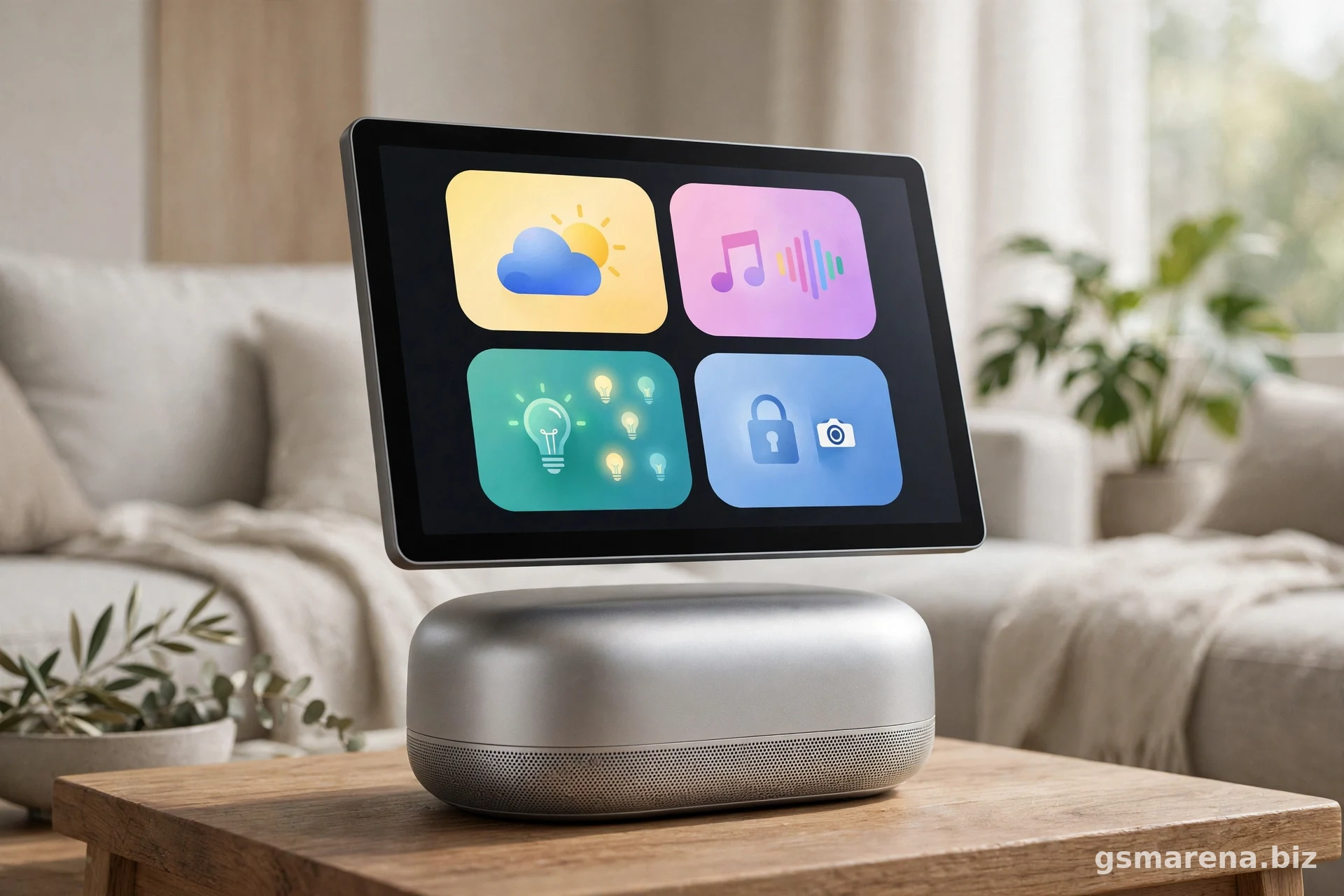
Apple has spent the better part of a decade circling the smart home. It built HomeKit, shipped the HomePod and HomePod mini, and watched Amazon and Google turn the humble smart display into a kitchen-counter staple. But it never made the one product that ties the whole thing together — a dedicated hub for the connected home. That changes now. Meet Apple HomeView, a smart home hub powered by the new Siri with Apple Intelligence, and it goes on sale next month.
A Long Time Coming
Rumors of an Apple smart display have floated around for years, surfacing in supply-chain leaks and analyst notes every few months like clockwork. Meanwhile, the competition did not stand still. Amazon’s Echo Show lineup and Google’s Nest Hub Max became the default screens for smart homes, handling everything from video calls to doorbell feeds to recipe walkthroughs.
Apple’s answer was never going to be a me-too product, and the company clearly waited until it had something genuinely different to say. That something is the new Siri. Rebuilt on Apple Intelligence, the assistant is now capable of holding natural, flowing conversations — and HomeView is the first device designed from the ground up to put that new Siri at the center of your home.
Two Designs, One Brain
HomeView comes in two physical forms, both built around the same 7-inch display module.
The Standard Model
The standard version is the showpiece. It uses a floating display design mounted on a rounded aluminum base, with a tilt-adjustable hinge so you can angle the screen toward wherever you are standing. It ships in four colors — silver, starlight, rose pink, and space gray — and each one comes with a matching cable, a small detail that tells you Apple sweated the aesthetics.
The Wall-Mounted Option
The second variant is the display module on its own, designed to be mounted on a wall. Mounts come from Schneider Home and are sold separately, so the wall version is aimed more at people planning a permanent installation — a kitchen command center, a hallway control panel, that sort of thing. It is only available in silver and space gray.
Display and Sound
The 7-inch LCD runs at a square-ish 1088×1088 resolution, which works out to 220 pixels per inch — sharp enough that text and widgets look crisp at arm’s length. Brightness peaks at 500 nits and drops all the way down to 0.3 nits at the minimum, so the screen can stay readable in a bright kitchen and still be gentle on the eyes in a dark bedroom. True Tone adjusts the color temperature to the room, and a fingerprint-resistant oleophobic coating keeps the touchscreen from turning into a smudge magnet.
Audio is where things get interesting. The display unit itself houses two full-range drivers, and the standard model’s base adds a downfiring woofer plus dual force-cancelling passive radiators. The result is Spatial Audio with Dolby Atmos support, tuned by computational audio that measures the room and adjusts the output to suit the surroundings. Whether HomeView ends up pulling double duty as a kitchen speaker remains to be heard, but the hardware suggests Apple is serious about sound quality.
Smarter Siri at the Center
Everything runs on the Apple A18 chip with custom software built specifically for the hub. But the real story is the new Siri. Powered by Apple Intelligence, it can hold a proper back-and-forth conversation instead of the stilted command-and-response pattern of the old assistant.
Apple is also leaning into continuity. You can start a conversation with Siri on HomeView and pick it up on your iPhone or iPad, or go the other way — ask something on your phone in the morning and continue the thread on the hub when you get home. For a household device that multiple people share, that kind of handoff could be the difference between a gadget and a genuine fixture.
Built for the Whole Household
Speaking of sharing, HomeView recognizes up to six members of a household. Personal content stays personal: iMessages and emails only surface for recognized users, so your texts won’t pop up in front of guests. Shared iCloud photo libraries and music, on the other hand, are accessible to anyone in the room. Each person can also customize their own homescreen widgets, so the display shows what matters to whoever is standing in front of it.
A Safety Trick You Didn’t Expect
Buried in the spec sheet is one of the more unusual features: four far-field microphones that don’t just listen for “Siri” — they can recognize the sound of smoke and carbon monoxide alarms. If HomeView hears one while you’re away, it can alert you. It is a clever use of always-on microphones that goes beyond voice commands, and it turns the hub into a passive safety net for the home.
On the privacy front, the camera is a 12MP f/2.4 ultra-wide with Center Stage, which keeps you framed as you move during video calls. Given that this is a camera sitting in people’s kitchens and living rooms, Apple will need to be loud about its privacy story — expect the usual on-device processing pitch.
Connectivity
HomeView speaks all the right wireless languages: Wi-Fi 802.11ax with MIMO, Bluetooth 6.0, and Thread networking for low-power smart home devices. Thread support is the important one — it is the backbone of the Matter standard, and it signals that Apple wants HomeView to play nicely with the broader smart home ecosystem, not just HomeKit gear.
Price and Availability
Both models cost $299, with wall mounts sold separately for the wall-mounted version. Pre-orders open today in Australia, Canada, India, New Zealand, the UK, and the US. Singapore joins on October 15, and the device goes on sale Friday, November 13.
One notable absence: the EU. Apple says HomeView will not be available in Europe because of Siri AI regulations, the same regulatory tangle that has kept some Apple Intelligence features out of the region. European smart home fans will have to wait — or import.
How It Stacks Up
The obvious comparisons are Amazon’s Echo Show 8 and Google’s Nest Hub Max, both of which have had years to refine the formula. On paper, HomeView’s advantages are the new Siri, the A18 chip, and Apple’s privacy-first positioning. The square 7-inch display is smaller than the Nest Hub Max’s 10-inch panel, so Apple seems to be betting that intelligence matters more than screen size.
The $299 price puts it above most Echo Show models but in line with premium smart displays. Whether that premium is justified will come down to one thing: whether the new Siri is actually as good as Apple says it is. If the conversational assistant delivers, HomeView could reset expectations for the whole category. If it stumbles, it is an expensive clock with a nice speaker.
Conclusion
The Apple HomeView is the product Apple smart home fans have been waiting years for — a dedicated hub that finally gives the new Siri a permanent place in the house. Two designs, a sharp 7-inch display, serious audio hardware, multi-user smarts, and even smoke alarm detection make for a compelling package at $299.
The open questions are the ones that matter most: how good the new Siri really is in daily use, and how quickly Apple can resolve the EU situation. But for everyone in the launch countries, pre-orders are open now, and November 13 can’t come soon enough for the Apple faithful.
Source: GSMArena – Apple announces HomeView with a 7-inch touchscreen and Siri with Apple Intelligence